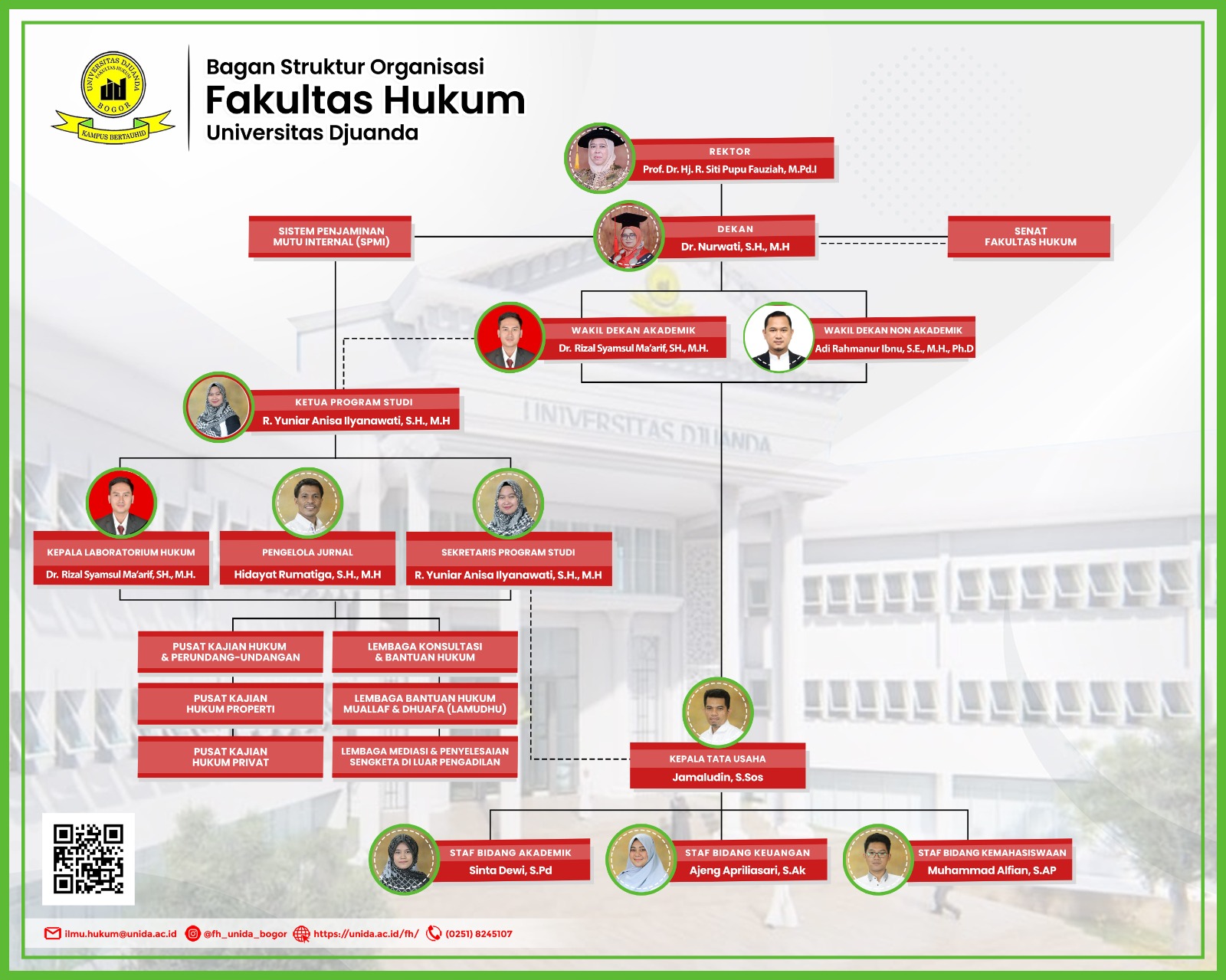
The Faculty of Law is one of the faculties within the Djuanda University (UNIDA) which was established by the Indonesian Amaliyah Islamic Study and Development Center Foundation (YPSPIAI) which was established based on Notarial Deed Number 2 of 1983 concerning the Deed of Establishment of the Islamic Study and Development Center Foundation. Then the Establishment of the Faculty of Law was based on the Decree of the Management of the Islamic Study and Development Center Foundation with Number 083/YPSPI/III/1987 concerning the Establishment of the Djuanda University College and obtained permission based on the Decree of the Minister of Education and Culture of the Republic of Indonesia Number 0231/0/1988. Dated April 30, 1988 The following is the journey of accreditation status:


To become an excellent law faculty that is committed to enlightening the life of the nation that is united in monotheism and has international standards.
Conduct legal education to produce graduates who are ethical and knowledgeable;
Conduct legal research and development to produce graduates with integrity and innovation;
Carry out community service and publish legal studies through legal advocacy;
Implement Pancadarma by prioritizing the principles of professionalism, integrity, and accountability;
Internalize the values of tauhid.
1. Educational Objectives
To provide education based on tauhid (Islamic monotheism) that is fair, accountable, dynamic, modern, and transparent in the learning process, using an integrated character-based curriculum aligned with societal development;
To develop an evaluation system in the management of knowledge, curriculum development, and learning processes based on competencies in accordance with the needs of the Bachelor of Law program and societal development;
To produce graduates who are grounded in tauhid, globally competitive, and successful technopreneurs;
To develop student activities focused on scientific development in the field of law and societal needs;
To build and continuously develop an alumni network.
2. Research Objectives
To encourage the improvement of the quality and quantity of faculty research published in national and international journals as a means of developing teaching materials and enhancing faculty professionalism;
To conduct research through research-based learning both on campus and in the community;
To realize a globally-minded and internationally recognized faculty to support UNIDA’s World Class University program by 2020;
To produce research publications oriented toward the downstream application of research results.
3. Community Service Objectives
To encourage the improvement of the quality and quantity of faculty community service published in national and international journals as a form of service to society;
To carry out community service through research-based learning both on campus and in the community;
To produce community service publications focused on the downstream application of community engagement results.
4. Professional Objectives
To develop the competencies of prospective law enforcers including pedagogical, personal, social, and professional competencies, all rooted in tauhid;
To deliver excellent service in education, research, and community service by upholding the principles of professionalism and tauhid to meet the satisfaction of legal stakeholders;
To build mutually beneficial cooperation networks in the field of law at regional, national, and international levels.
5. Tauhid-Oriented Objectives
To cultivate a tauhid-based campus life culture among all members of the Faculty;
To produce legal practitioners with Islamic, scholarly, and educational character;
To increase the involvement of study programs, both lecturers and students, in community empowerment activities.
The realization of tauhid-based education that is fair, accountable, dynamic, modern, and transparent in the learning process, based on a character-integrated curriculum aligned with societal development;
The achievement of quality and quantity in faculty research published in national and international journals as a means of developing teaching materials and enhancing faculty professionalism;
The improvement in quality and quantity of community service conducted by faculty members, published in national and international journals as a form of service to society;
The realization of excellent service in education, research, community service, and the establishment of mutually beneficial partnerships in the field of law at regional, national, and international levels;
The cultivation of a tauhid-based campus life culture among all members of the study program.